
Remote Robotics Data Engineer – The race toward Artificial General Intelligence (AGI) is no longer just about writing smarter algorithms—it is about training models on high-quality, real-world data. Embodied AI and robotics are at the absolute center of this evolution. Companies worldwide are searching for specialized talent capable of bridging the gap between physical machine movements and advanced machine learning models.
Remote Robotics Data Engineer – If you are looking to build a career at the absolute cutting edge of artificial intelligence, a remote role as a Member of Technical Staff within a specialized Robotics Lab offers an unparalleled opportunity to shape how future machines perceive, move, and interact with the world around them.
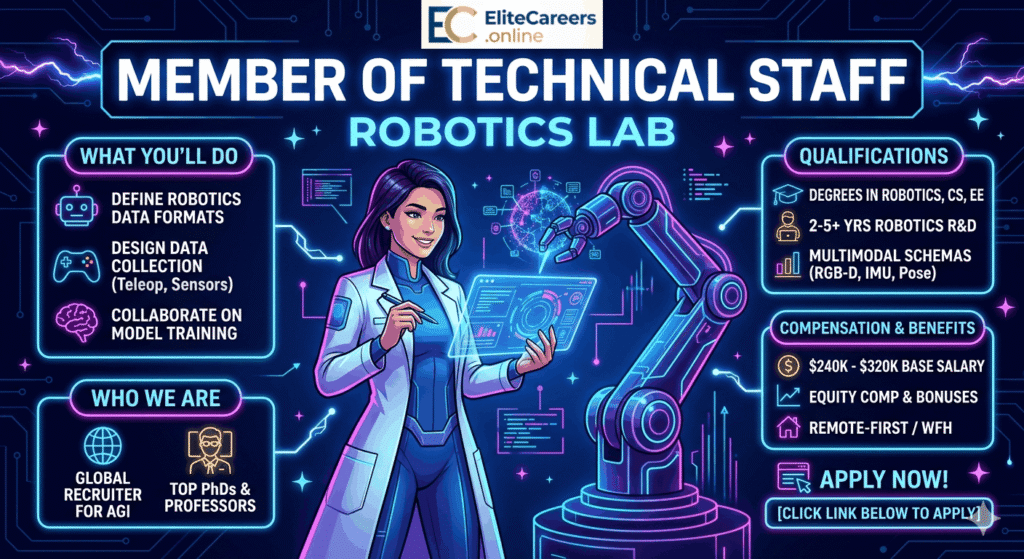
Understanding the Role of a Robotics Data Engineer in the AGI Era
In the modern tech ecosystem, data is infrastructure. For frontier AI labs, the biggest bottleneck isn’t computing power; it is high-signal training datasets. This is where a Robotics Researcher and Data Specialist becomes indispensable.
Instead of focusing solely on legacy hardware engineering, modern robotics specialists design the structural pipelines that allow AI systems to learn from physical demonstrations, sensor arrays, and multimodal inputs. When you step into a Member of Technical Staff position, you aren’t just programming a robot to perform a singular task—you are building the data frameworks that will teach entire generations of autonomous systems how to think, adapt, and execute tasks across diverse industries.
The Strategic Importance of Embodied Data
Embodied AI refers to artificial intelligence that interacts directly with a physical environment through a body or sensor suite. To make these systems effective, engineering teams require precise data schemas that capture:
Visual Inputs: High-definition RGB-D data streams.
Spatial Awareness: Real-time pose estimation and IMU (Inertial Measurement Unit) telemetry.
Instructional Context: Language models paired directly with physical actions.
By defining and standardizing these formats, you create the bedrock upon which top-tier AI labs train models capable of zero-shot generalization.
Core Responsibilities: What You Will Do in the Robotics Lab
Working in a high-growth AI infrastructure environment requires a unique blend of core research engineering and practical data management. Here is a breakdown of the core daily responsibilities expected in this elite position:
1. Data Schema Standardization & Benchmarking
You will take charge of defining, creating, and standardizing robotics data formats. This means structuring complex datasets so they can be seamlessly ingested by advanced machine learning models. You will establish the benchmarks that determine whether training data is clean, accurate, and scalable.
2. Advanced Data Collection Methods
Teaching a machine requires high-fidelity inputs. You will design, build, and deploy innovative data collection methods. This involves setting up human demonstration frameworks, teleoperation (teleop) systems, and specialized sensor arrays to capture intricate physical movements with pixel-perfect accuracy.
3. Cross-Functional Pipeline Collaboration
Data cannot exist in a vacuum. You will act as a vital bridge between hardware engineers, data annotation teams, and frontier AI research scientists. By collaborating across disciplines, you ensure that the data collected perfectly aligns with the training requirements of next-generation foundational models.
4. Dataset Evaluation & Quality Control
Massive data is useless without high signal quality. You will continuously analyze, evaluate, and audit datasets for diversity and scalability. Your insights will directly prevent algorithmic bias and training drift, ensuring the AI learns from a balanced, comprehensive spectrum of physical scenarios.
Key Qualifications and Experience Required
To thrive in a high-compensation, remote-first AI research environment, candidates must demonstrate a strong technical foundation alongside the adaptability required for rapid R&D environments.
Technical Skill Prerequisites
Professional R&D Experience: 2 to 5+ years of dedicated experience within robotics research and development, data engineering, or applied machine learning research.
Pipeline Mastery: A deep, practical understanding of robotics data pipelines and multimodal schemas, including hands-on familiarity with RGB-D, IMU, pose estimation, and language alignment.
Core Concepts: Solid exposure to robot perception, motion control, or data-driven imitation learning frameworks.
Academic Background: A Bachelor’s, Master’s, or PhD in Robotics, Computer Science, Electrical Engineering, or a highly related technical field.
Preferential “Bonus” Assets
While not strictly mandatory, candidates can significantly set themselves apart during the interview process if they possess:
Prior career experience at a top-tier robotics manufacturer or frontier AI development lab.
Deep familiarity with complex embodied AI datasets and imitation learning pipelines.
Hands-on experience prototyping physical sensors and custom hardware interfaces.
Compensation, Premium Benefits, and Corporate Culture
Exceptional talent deserves elite compensation. This position offers a highly competitive salary package alongside a robust suite of corporate benefits designed to support a high-performing, remote-first workforce.
| Benefit Category | Package Details |
| Base Salary Range | $240,000 to $320,000 USD / Year |
| Equity Components | Eligible for corporate equity compensation packages |
| Bonuses | Performance-based bonuses dependent on role milestones |
| Health Insurance | Up to 100% premium reimbursement for health coverage |
| Retirement Planning | 401(K) retirement plan complete with a company match |
| Work Environment | 100% Remote-first autonomy with flexible paid time off (PTO) |
Equal Opportunity and AI-Driven Assessment
The hiring team operates as an equal opportunity employer, evaluating all qualified applicants without regard to race, color, religion, sex, national origin, or protected status. The initial candidate screening process utilizes sophisticated AI recruiting models to complement human decision-making, ensuring a fast, fair, and high-signal assessment process for every applicant.
Frequently Asked Questions (FAQs)
What exactly is “Embodied AI”?
Embodied AI is the subfield of artificial intelligence where an AI agent interacts with its physical environment through a body, sensors, or robotic hardware, moving beyond text or static image generation into real-world action.
Is this a fully remote position for international candidates?
This role is a remote-first position designed for US-based professionals or those aligned with US time zones, offering complete geographical flexibility within the domestic market.
What are the main data formats used in this robotics role?
The role heavily focuses on multimodal data schemas, including visual depth data (RGB-D), inertial data (IMU), spatial positioning (pose), and natural language instructions.